A Full Arena PA Now Fits in Half a Truck: The L-Acoustics L1 Math
L-Acoustics' new L1 line array compresses the audio package for a full arena tour into roughly half a 53-foot trailer. Here is the math on cabinet count, weight, and trailer volume, plus what 30 years of PA shrinkage means for touring logistics.

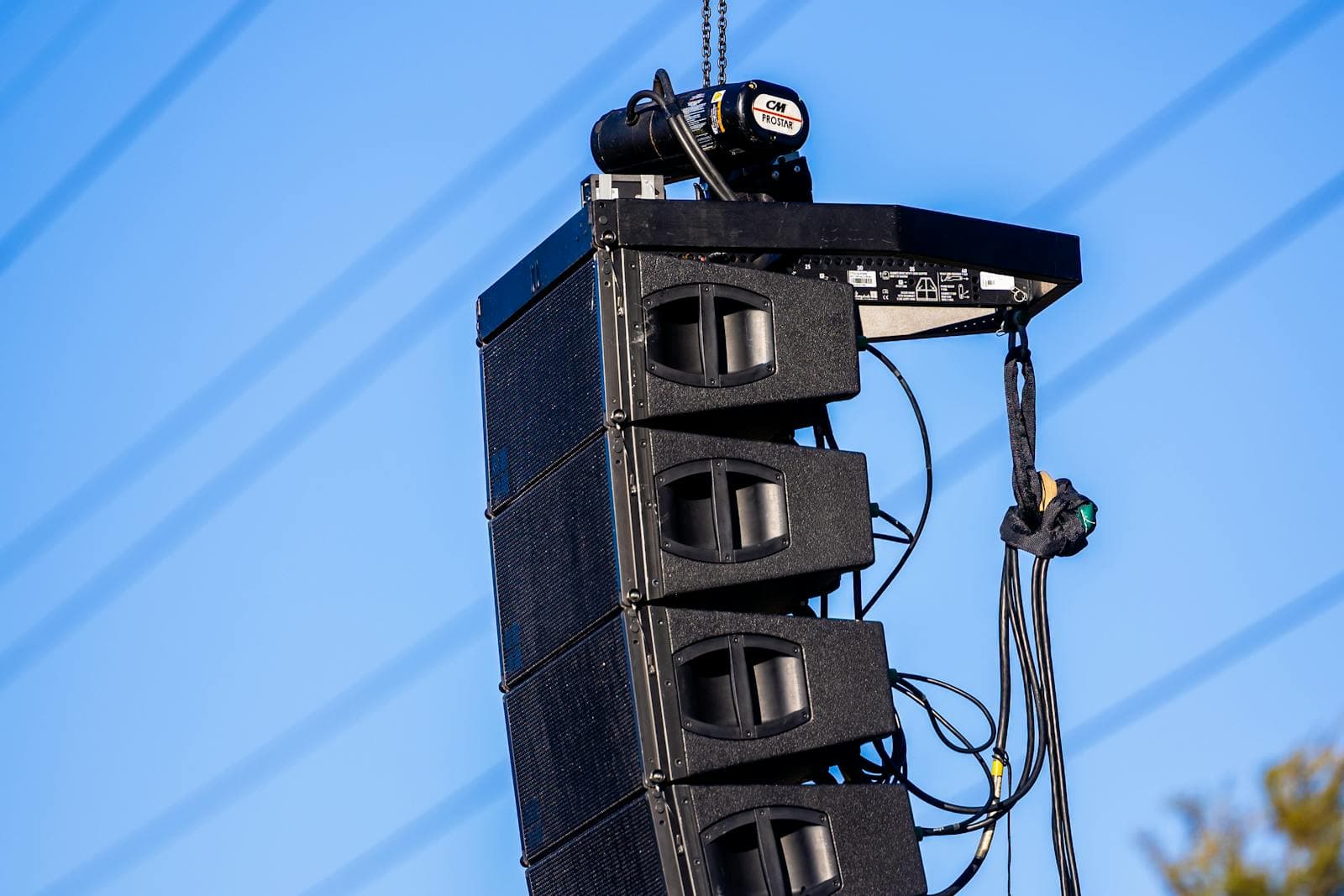
In 1992, L-Acoustics unveiled V-DOSC and quietly invented the modern line array. A full arena PA at the time meant 24 to 32 V-DOSC boxes per side hung on bumpers heavy enough that the trim chain math was its own job. The audio package for a major arena tour typically required two trucks, and the FOH engineer kept a tape measure in their kit so they could explain to the local steward why the trim height was different than yesterday.
Thirty-four years later, in May 2026, the same company introduced the L1. A ten-element L1 array (nine L1 cabinets plus one L1D terminal element) delivers the performance of a thirty-element K1 deployment (L-Acoustics: Introducing L1 and CS1). The audio package for an L1-equipped arena tour now fits comfortably in less than half of a single 53-foot trailer. We did the math and want to walk you through it, because the implications for touring logistics go well beyond the audio department.
What the L1 actually is
The L1 is L-Acoustics' new flagship line source, designed for stadiums, arenas, and the largest festivals. Each enclosure is a fairly serious physical object on its own:
- L1 dimensions: 1500 mm wide x 1005 mm tall x 750 mm deep (59 in x 39 in x 30 in)
- L1 weight: 256 kg (564 lb)
- L1D dimensions: 1500 mm wide x 1167 mm tall x 750 mm deep
- L1D weight: 239 kg (527 lb)
- Maximum SPL per enclosure: 160 dB on L1, 155 dB on L1D
- Bandwidth: 35 Hz to 20 kHz, full range
- Transducers per enclosure: two side-mounted 18-inch cardioid drivers, four front-firing 15-inch LF drivers, eight 8-inch MF drivers, and six coaxial 4-inch + 2.5-inch HF compression drivers
That last spec is the unusual one. Twenty individual drivers per cabinet, all individually amplified through the LA7.16 controller (one amp per box, sixteen output channels per amp). The cabinet is a single object on the rigging system but it behaves like a 20-element processed array in software.
Two technologies do most of the work. PULS (Progressive Ultra-Dense Line Source) packs the transducers tightly enough to hit nearly 100% active radiating factor per box, which is what lets ten L1 cabinets do the work of thirty K1 cabinets (L-Acoustics: L1 System product page). Panflex provides tool-free horizontal pattern control directly on the cabinet, swapping between 70, 80, and 90 degree coverage modes without flying a different SKU.
The headline weight comparison is worth pausing on. A main hang of four L1 plus one L1D weighs 1,263 kg. The equivalent-output K1 array would be fifteen boxes weighing 1,590 kg. Fewer boxes flown for more performance, lower hang weight, less rigging burden.
The arena PA package, in cabinets
A typical modern arena audio package on L1 looks something like this:
- Two main hangs: 9 L1 plus 1 L1D per side, 20 cabinets total (18 L1, 2 L1D)
- A flown sub array: 12 to 16 cardioid subs (CS1 is the L1's purpose-built sub companion)
- Side hangs or 270 fills: 6 to 10 L2 or K-Series cabinets for off-axis coverage
- Front fills, lip fills, and delays as the venue demands
The amplification math is one-to-one. Each L1 needs its own LA7.16 controller. With 20 mains and roughly 12 to 16 subs, that is 32 to 36 LA7.16 amps. The LA-RAK III touring rack holds three amps each, so you are looking at 11 to 12 amp racks for the entire system.
Rigging: two L1-BUMP flying frames, plus a couple of L1CS1-BUMPFLIGHT cases for transport. Motor controllers, span sets, cable, spares.
How much trailer space that actually takes
A 53-foot dry van interior is 16.154 m long by 2.591 m wide by 2.743 m tall, giving you roughly 115 cubic meters of internal volume and somewhere around 20,000 kg of legal payload capacity (depending on tractor and trailer tare weight).
Now the math.
Mains carting. Cabinets travel on dedicated L1-CHARIOT carts, two L1 per cart, one L1D per L1D-CHARIOT. The 20-cabinet main package rides on 11 carts. Each cart occupies roughly 1.5 m x 0.85 m of floor area (the cabinet width plus the cart frame), so 11 carts cover about 14 square meters of trailer floor. The trailer floor is 41.85 square meters total. That is 33 percent of the floor, used.
Subs. A 12-element sub array stacks on dollies in a similar footprint to the mains. Call it another 8 to 10 square meters of floor.
Amplification. 11 LA-RAK III racks are touring-standard rolling racks, roughly 0.7 m x 0.8 m each. That is another 6 square meters of floor.
Frames, side hangs, accessories. Flying frames travel in their own cases. Side hangs ride on smaller carts. Cable trunks, motor cases, spare cabinets. Call that 8 square meters.
Total floor used: roughly 36 to 38 square meters out of 41.85 available. Total cargo volume used: roughly 43 to 50 cubic meters out of 115 available, or 37 to 43 percent.
Total package weight: 20 mains at average 250 kg = 5,000 kg, 12 subs at roughly 90 kg = 1,080 kg, 11 amp racks at roughly 100 kg = 1,100 kg, frames and accessories around 1,500 kg. Call it 9,000 kg of payload, against a legal limit of roughly 20,000 kg. You could carry the package twice and still be legal.
By any measure (floor area, volume, or weight) the audio package for a full arena tour now fits inside roughly half of a single 53-foot trailer. See the actual pack in 3D here. The L1 cabinets, carts, amp racks, frames, and subs are all modeled at real dimensions, in a real 53-foot trailer, so you can spin it around and confirm the math for yourself.
What this used to look like
The historical comparison is the part that should land for anyone who has been doing this for a while.
V-DOSC (1992): an arena rig of 24 cabinets per side was typical. That is 48 main cabinets per show, each cabinet 89 cm x 91 cm x 71 cm and 79 kg. Add subs, processing, racks of analog amps, and the audio package routinely needed two full trucks.
K1 (2008): the modern reference for the last fifteen years. K1 cabinets are smaller (1.4 m x 0.39 m x 0.75 m, 106 kg), and the amplifiers shrank significantly. An arena tour on K1 typically packed audio into a single trailer, with monitors often catching a partial split with another department.
L1 (2026): half of one trailer for everything described above. The other half of the trailer is available for monitors, RF, a workbox or three, and the kind of operational comfort that is currently a luxury.
Three decades, three generations, the same arena, and the cubic-meter requirement for audio has fallen by roughly 70 percent.
What changed under the hood
Three things compounded:
Driver density. L-Acoustics' PULS architecture pushes the active radiating area per cabinet close to its theoretical maximum. More energy out of less surface area is what enables ten L1 cabinets to outperform thirty K1.
Amplification. The LA7.16 is a single-rack-space amplified controller driving sixteen output channels. A K-class amp rack from 2008 doing the equivalent processing and amplification took two or three times the rack space, drew more power, and threw off significantly more heat. Reducing the amp footprint and the power and HVAC requirements at FOH world has knock-on effects on the rest of the rig.
DSP and Autofilter. What used to be done by adding more boxes to physically aim energy at the right seats is now done by FIR filters and Autofilter optimization in software. Coverage that previously required additional cabinets is now firmware. Boxes are smarter, so you need fewer of them.
What this means for touring logistics
The audio shrinkage is real and it shows up in the truck pack. Concrete consequences:
Truck count drops or stays flat with more departments. A 1990s headline tour ran 14 to 18 trucks. A 2010s K1-era arena tour typically ran 10 to 14. A new arena tour speccing L1 can hit similar production scale on 8 to 10 trucks because audio takes half of what it used to. Or, more interestingly, the same truck count now accommodates a bigger video rig, more automation, a larger scenic package, or more comfortable production design margin.
Crew sizes adjust. Fewer cabinets to fly is fewer riggers and audio hands needed for the up-and-down. Loadmasters can re-balance call sizes against actual labor needed.
Load-out times shrink. L-Acoustics quotes up to three times faster deployment versus traditional line arrays. Even discounting some marketing in that number, faster load-out is fewer overtime hours, more flexible push windows, and earlier truck calls on the road.
Environmental and budget math improves. Fewer trucks moving the same show is straightforward operating-cost and emissions reduction, both of which now show up in major-tour environmental impact reports.
The math affects rental pricing. Audio rental companies can move the same level of production with fewer trucks and fewer techs. That changes day rates, transport surcharges, and how packages get bid in competitive scenarios.
What it does not change
None of this means a smaller PA sounds smaller. The whole point of L1 is that the SPL per cabinet, the directivity control, and the tonal consistency are all better than what you had before, not worse. The shrinkage is on the logistics side, not on the audience experience side. A correctly designed L1 system in a 15,000-seat arena should outperform a K1 system in the same room while occupying significantly less stage space and significantly less truck space.
The flying frame is still a flying frame. The trim height calculations still matter. The local steward still has opinions about your motor placement. What changed is how much of the trailer the audio package needs to claim before everything else fights for what is left.
What we do with this at Truck Packer
Modeling a tour rig in 3D used to mean trying to estimate where audio was going to land after the loadmaster pre-pigged in their head. With L1 dimensions now public (1500 x 1005 x 750 mm per cabinet, 256 kg per L1, 239 kg per L1D), Truck Packer can model the exact carting, the amp racks, the flying frame transport cases, and where the rest of the production fits around them. Here is the actual pack we built showing the L1 audio package inside a 53-foot trailer. The half-empty trailer is the new design constraint. What you put in the other half is the new conversation.
Where the trend goes next
L-Acoustics is not the only player here. d&b audiotechnik, Adamson, and Meyer Sound have all moved in the same direction over the same period. The trend is industry-wide: more driver count per cabinet, fewer cabinets per array, smarter DSP, smaller and lighter amplification. Every generation removes a layer of physical mass for a tier of processing.
If V-DOSC was the moment line arrays started, L1 is the moment line arrays got dense enough that a major arena production stops needing a dedicated audio truck at all. The audio package becomes a component of a larger truck pack, not the dominant consumer of it.
That is a meaningful shift, and it changes the conversation about every other department on the production. More room for lighting motors. More room for video pre-rig. More room for a wardrobe truck that does not also have to share with backline.
The math that used to be "how many trucks does the PA take" is starting to look like "where in the trailer should the PA sit so that everything else loads around it."
Stop reading, start packing: log in to Truck Packer and lay out your trailer.

