LD3 Container Dimensions: Will Your Fly-Away Rig Fit?
LD3 container dimensions in inches and cm: 61.5 x 60.4 in base, 64 in tall, 79 in roof, 1,588 kg max gross. Why the angled base strands case volume, a real fly-away audio kit packed into one LD3, and how the PMC pallet compares.

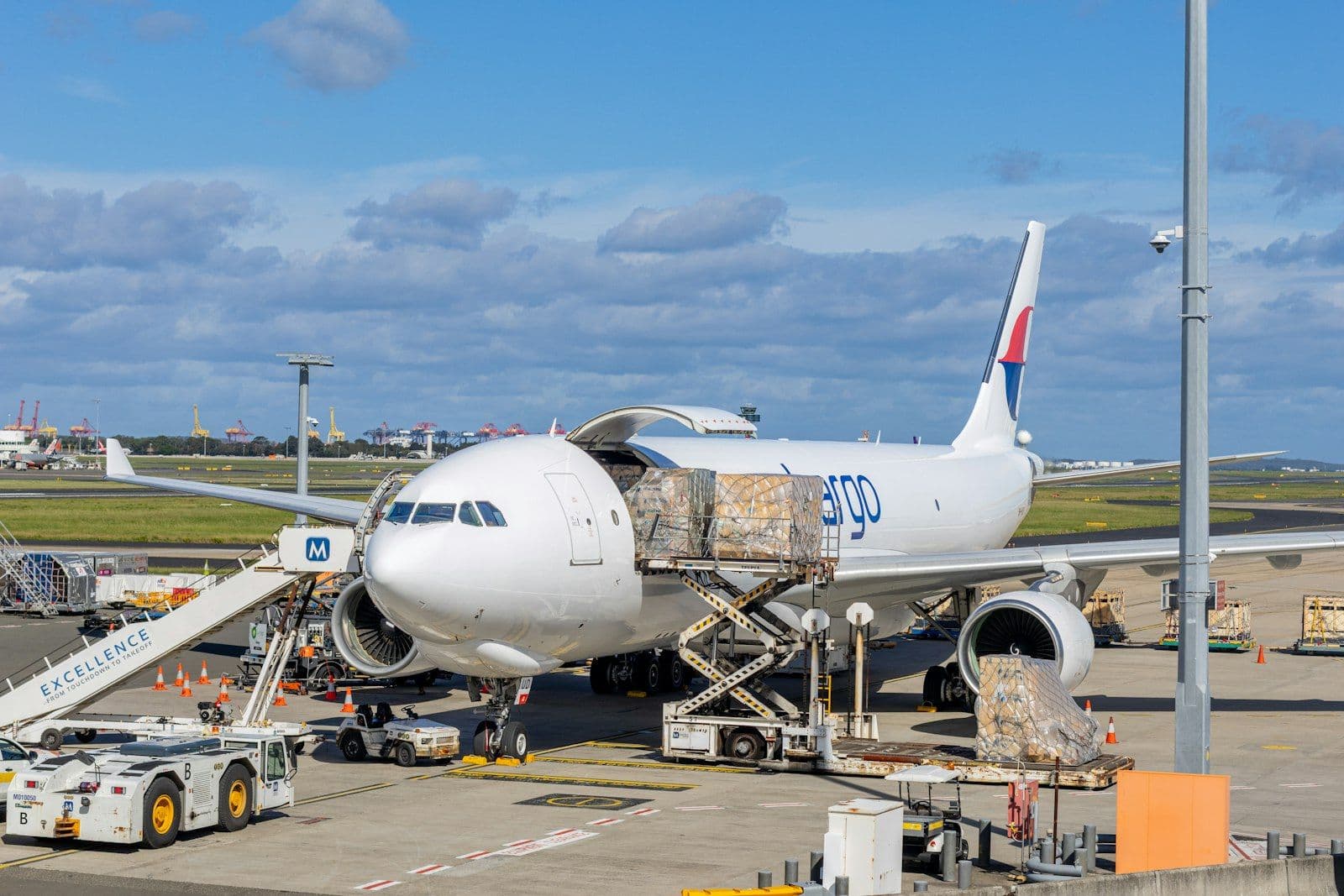
An LD3 container is 61.5 x 60.4 inches at the base, 64 inches tall, and 79 inches across the roof, and it tops out at 1,588 kg (about 3,500 lb) gross. That's the short answer. The longer one is why a fly-away rig that looks like it fits on paper still strands space in an LD3, and what a real audio kit looks like packed into one.
LD3 container dimensions
The LD3, IATA code AKE, is the workhorse lower-deck container on widebody passenger aircraft. Per DSV's LD3 spec sheet and Hansatic's ULD guide:
- Base: 156.2 x 153.4 cm (61.5 x 60.4 in)
- Roof: 200.6 x 149.4 cm (79 x 58.8 in)
- Height: 162.6 cm (64 in)
- Internal volume: about 4.5 cubic meters (Freight-Academy puts the interior at 156 x 153 x 163 cm)
- Door opening: 147 x 155 cm (ship4wd)
- Tare: 82 kg
- Max gross: 1,587 to 1,588 kg, depending on the source
Subtract the tare from the gross and you've got roughly 1,506 kg (3,320 lb) of payload. The one-kilogram gap between sources is rounding, so plan to the lower number. Freight-Academy also notes that exact interior dimensions vary a little by build year and manufacturer, so check with your carrier before you book.
Why the angled base strands case volume
The roof is 79 inches long and the base is 61.5. That's because one lower corner is cut away at an angle to follow the curve of the fuselage. For case stacking, the full rectangle you can actually stand cases on is about 156 x 153 cm, and only short items can ride out over that angled shoulder. Road cases are rectangles, so in practice you're packing a 61 x 60 x 63 inch box and giving up the contour.
Height is the other trap. A 12U shock rack on castors runs around 33 inches tall, so two of them stacked come in right around 66 inches. That's over the LD3's 64 inches before you count a lid lip. In a truck you'd never think twice about stacking them. In an LD3 they ride side by side on the floor, and that choice sets the rest of the pack.
A real fly-away kit in one LD3
To see how this plays out, I packed a small fly-date audio package into an LD3 in Truck Packer, using the usable 61 x 60 x 63 inch box: a FOH console case, two 12U shock racks, a 6U IEM rack, a cable trunk, a mic and DI trunk, a stage box with tails, and a mic stand bag. Here is the pack if you want to open it yourself.
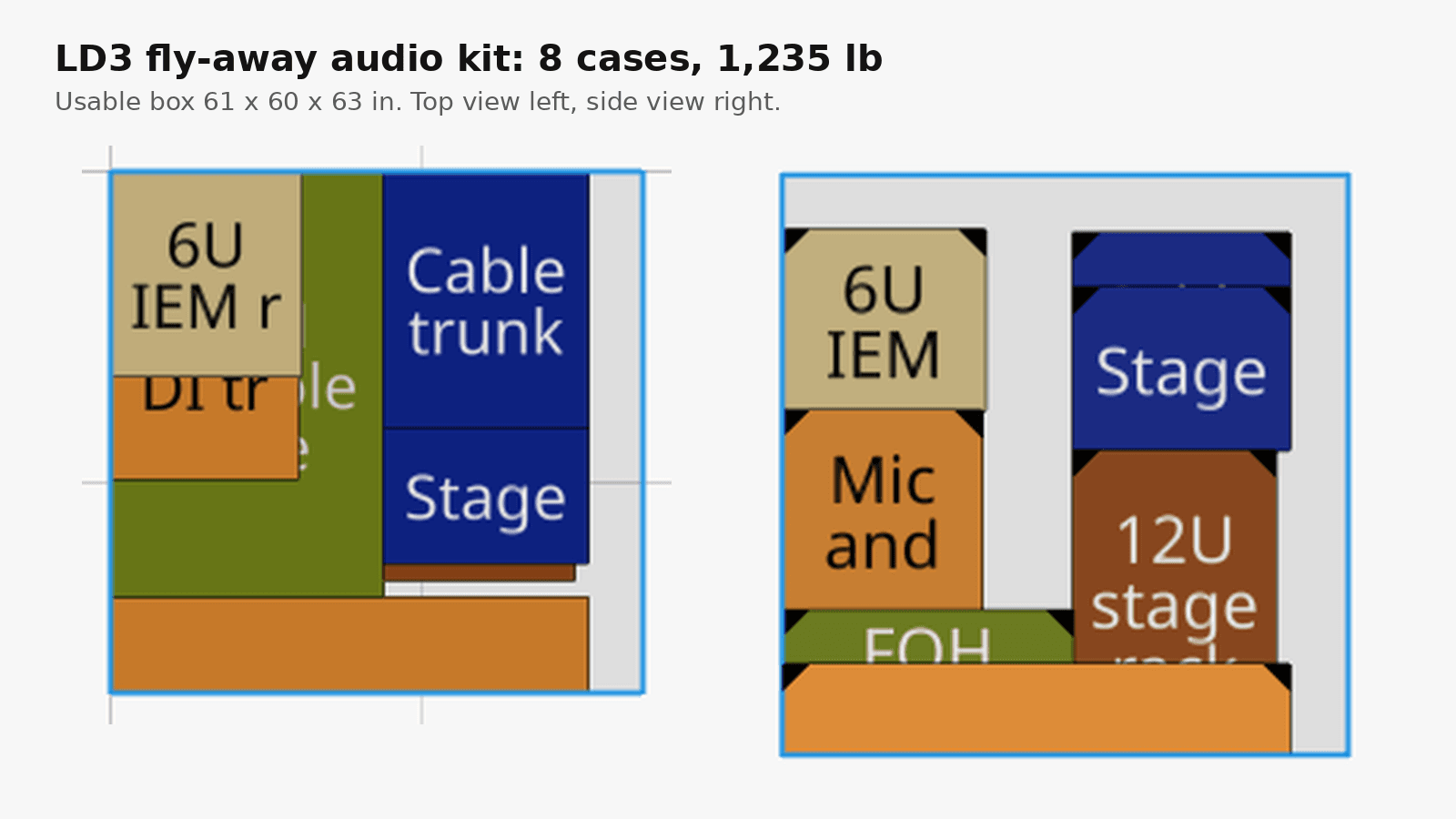
Eight cases, 1,235 lb, in the usable 61 x 60 x 63 inch LD3 box. Console and both racks on the floor, lighter trunks on top.
All eight cases fit at 1,235 lb, which is well under the 3,320 lb payload. The console case goes flat on the floor, and the two racks stand next to it. The cable trunk and stage box ride on the racks, and the mic trunk and IEM rack go on the console lid. The mic stand bag slides into the strip along one wall. Weight is never the limit on a kit like this. The floor and the height are. The stack tops out at 57 inches, and the leftover room is mostly slivers that nothing in a normal case set fits into.
LD3 vs PMC
When the rig outgrows an LD3, the next shape is the PMC pallet, IATA code P6P. DSV's PMC sheet lists it at 317.5 x 242.8 cm (125 x 96 in) with a 120 kg tare, a max gross of 4,626 to 5,035 kg on the lower deck depending on aircraft, and 6,800 kg on the main deck. That's where line array cases, amp racks, and motor crates actually travel.
LD3s ride the lower deck of widebodies like the B767, B777, A330, and A350 (Hansatic), which means belly freight on the same flights the crew is on. The heavy PMC build-ups need main-deck positions on freighters like the B747. Narrow-body regional hops take neither, which is why fly-away packs that tour on 737s get broken down to loose-loadable cases.
How air freight bills bulky gear
Air freight bills chargeable weight, not just actual weight. The standard IATA ratio is 1:6000, so volume in cubic centimeters divided by 6,000 gives volumetric kilograms (Freightos), and you pay whichever is higher. Touring gear is the worst case here: empty racks, doghouses, and foam-lined console cases are mostly air. A case set that fills an LD3's 4.5 cubic meters bills around 750 kg even if it scales at 500.
Model it before you book the fly date
Manufacturers already think this way. SSL's TCA Tour is pitched as a "compact fly-away audio production system," pre-wired so the console travels as one deployable unit instead of a control surface plus a rack farm. Your whole case set deserves the same treatment. Set up a container at the LD3's usable box (61 x 60 x 63 in) or a PMC footprint (125 x 96 in to your carrier's height limit), drop in your real case sizes, and you'll see what fits, what strands volume, and how many ULD positions you're actually booking before the freight quote shows up.
Flying a rig soon? Log in to Truck Packer and pack it into an LD3 first.

