Sea Container Sizes: Plan on a 40ft High Cube and a 92-Inch Door
On most ocean moves, plan on a 40ft High Cube with a door 92 inches wide. What box to expect on a sea move, what else you might get, and why a trailer pack won't transfer row for row.


On most ocean moves you should plan on a 40ft High Cube, which means a door 92 inches wide and 102 inches tall, no matter how much room the box has inside. Someone asked me about sea containers this week, and the question wasn't really about specs. They wanted to know what shows up when you book a sea move, and whether the truck pack they already have will go in it. Our 20ft vs 40ft spec post has the full comparison. This one is about what to expect and what changes when the gear leaves a trailer.
Plan on a 40ft High Cube: 76.3 cubic meters and a 102-inch door
Source: Hapag-Lloyd Container Specification
The High Cube is the box to plan around. Hapag-Lloyd lists it at 39 ft 5 5/8 in long and 8 ft 10 1/4 in high inside, with 76.3 cubic meters of capacity. High Cubes were just short of 50 percent of the maritime fleet at the end of 2013 per Drewry, and that's the last public census number I could find, so treat it as a direction and not a current count. Your forwarder confirms the equipment, but this is the safe assumption for planning.
The other three: 20ft at 33.2 cubic meters, 40ft at 67.7, 45ft at 86.0
Source: Hapag-Lloyd Container Specification
A 20ft is still common, and Drewry said in 2022 it expected the size to stay above 25 percent of the fleet. It has 33.2 cubic meters and the shorter 7 ft 6 1/4 in door. A standard 40ft has that same door height with 67.7 cubic meters. A 45ft High Cube gets you 86.0 cubic meters, but don't draw a plan on one until your forwarder says your lane has it. The 53-footer is off the list. It's mainly a North American domestic box, and the ISO size table in Hapag-Lloyd's spec stops at 45 ft.
The door is 92.1 inches wide, so 96 inches of cases won't go side by side
Source: Hapag-Lloyd Container Specification
This is what catches touring crews. The door opening on all of these boxes is 2,340 mm, or 92.1 inches, even where the walls measure a little wider inside. Truck Packer's 53-foot preset is 102 inches wide, so your trailer pack probably doesn't transfer row for row. Three 30-inch cases across is 90 inches and fits. Four 24-inch cases, or two 48-inch cases, is 96 inches and doesn't. Height moves too: a High Cube door clears 102.2 inches, and a standard door clears 90.2.
Road cases fill the space long before they hit the 63,052-pound payload
Source: Truck Packer load plan, 47 road cases modeled in a 40ft High Cube at Hapag-Lloyd's interior dimensions, with weights assumed
Here's the pack: 15 amp racks with 15 cable trunks on top, 16 fixture cases, and a console. It uses 468 of the 474 inches of length. The cases add up to 51.7 cubic meters, or 68 percent of rated capacity, because a real load leaves air. It weighs 11,089 pounds, about 18 percent of the payload on Hapag-Lloyd's steel box. The tallest stack here is 84 inches, so it would clear a standard door too. The High Cube only earns its place once you have tall cases or want a higher stack. Fixture cases went in as pinwheeled pairs, 48 inches beside 40, because 88 inches clears the door and 96 doesn't.
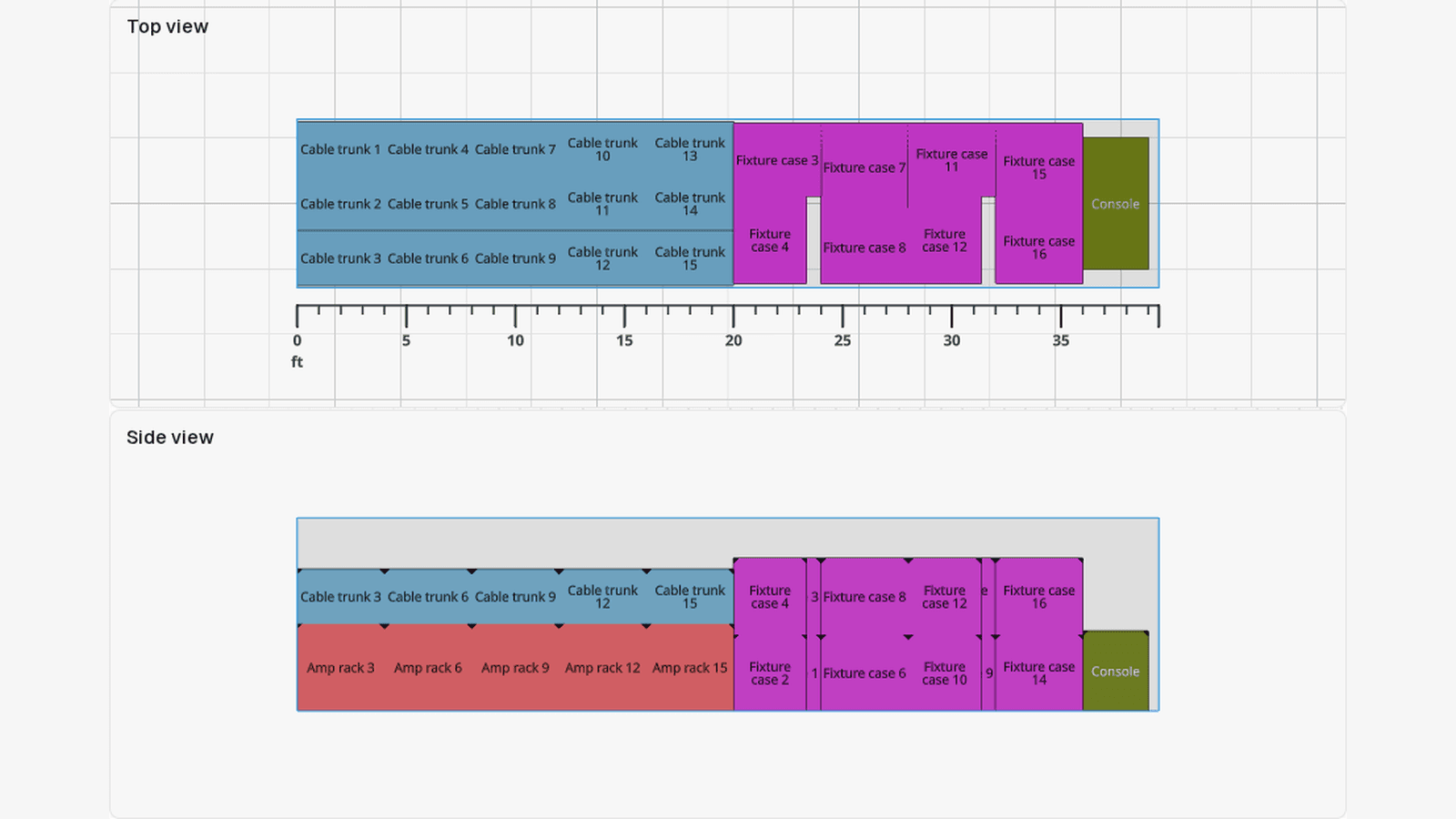
Top and side views. The pack runs 468 inches of a 474-inch box.
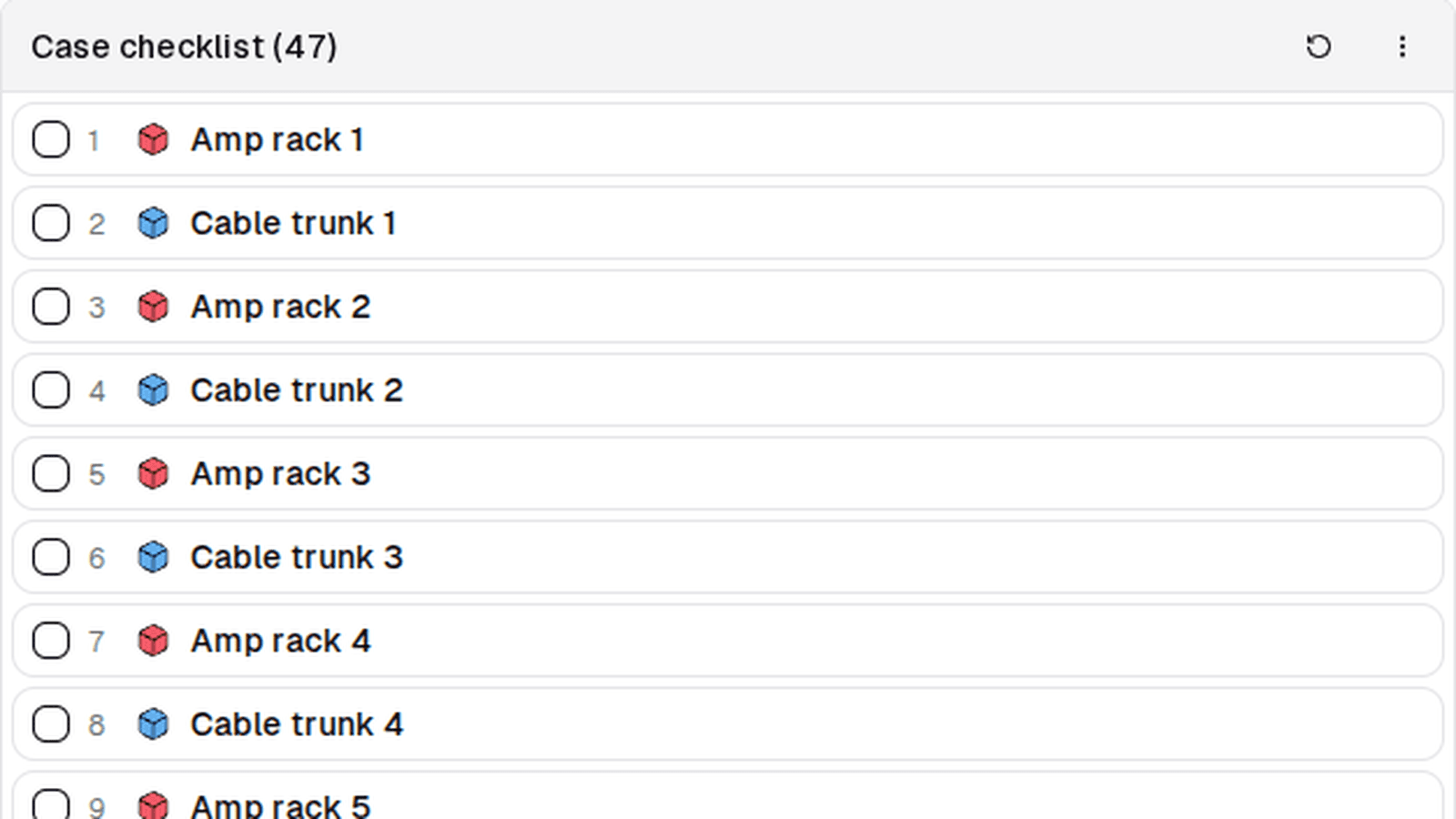
The checklist, which is what the crew stuffing the box works from.
In the US, a 40ft can be capped at 44,000 pounds of cargo on the road
Source: Hapag-Lloyd North American Inland Weight Guide
The box's payload isn't the road's payload. Hapag-Lloyd's inland guide lists 44,000 pounds of cargo in a 40ft for Los Angeles and 56,000 for Nashville. Touring gear rarely gets near that, but a steel-heavy load can, and we cover why that happens in the overweight post.
Every point you strap to is rated at 2,205 pounds
Source: Hapag-Lloyd Container Specification
Lashing points on the rails and corner posts are rated at 1,000 kg, or 2,205 pounds, each. Casters are the thing to think about here, because a box at sea moves in ways a trailer doesn't, so plan how every rolling case gets held in place. You'll also need a weight on file before it sails. Under SOLAS, the shipper has to provide a verified gross mass or the container can't legally be loaded. Anything too tall for the door goes in an open top or on a flatrack, so bring that up early.
Sea freight is the practical option for big rigs between continents because you trade speed for a lower cost per cubic meter. Get the widths right before the gear leaves the shop, because nobody wants to find out at the door.
Moving gear overseas? Log in to Truck Packer and pack it in a 40ft High Cube first.

