Truss Decides Two Trucks or Three
Box truss eats trailer floor fast. Using Tomcat 12x12 and 20.5x20.5 specs, a 53-foot trailer and a real truss dolly, here's the math on why 400 feet of big truss can cost you a third truck.

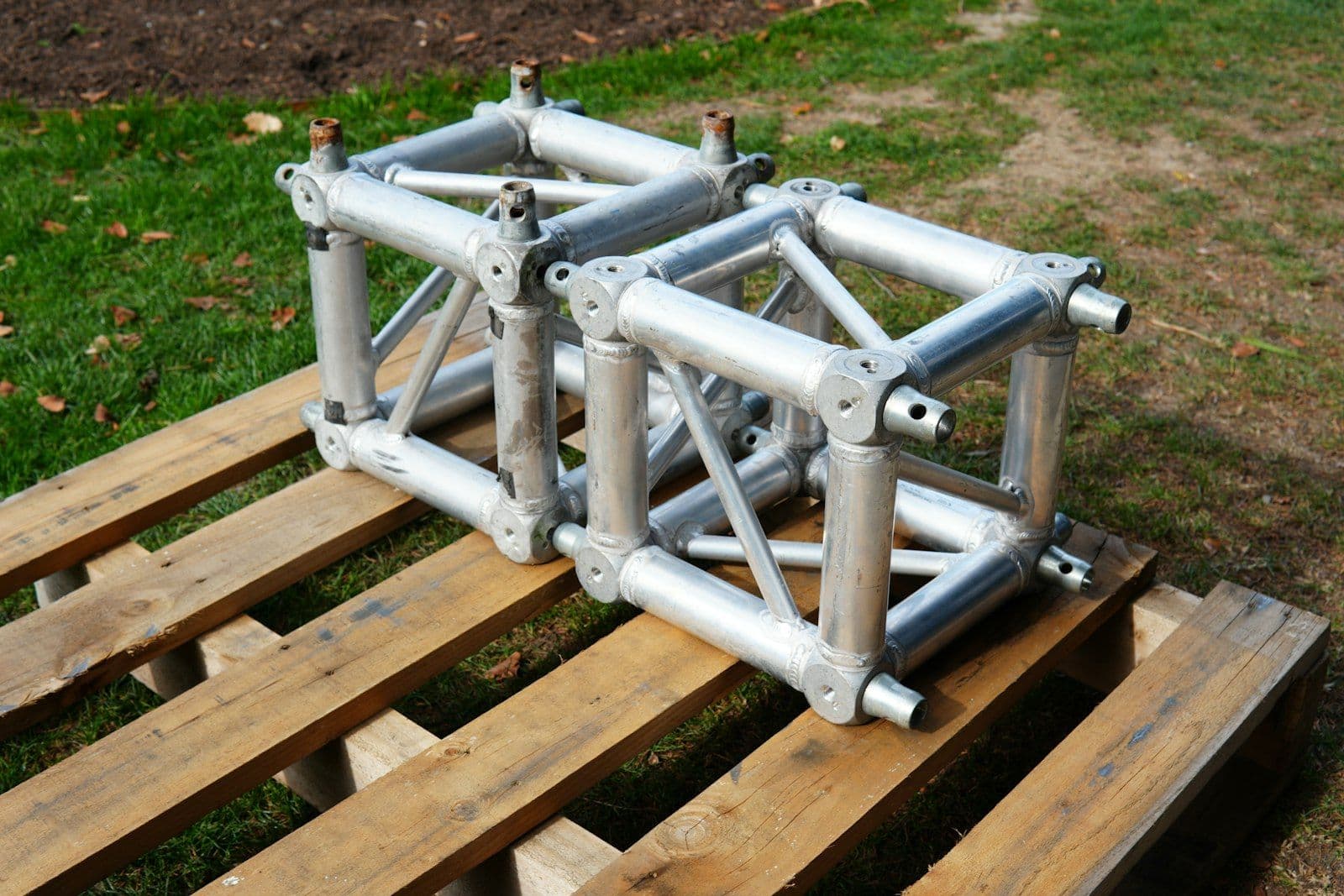
When we added seven truss makers to the case library, I wrote that truss is what decides whether you are on two trucks or three. That's a big claim to toss off in a release post, so here's the math behind it. It's pencil math with the assumptions out in the open, and your trailer and your dollies will move the numbers a bit. The shape of the answer doesn't move.
The two sticks
I picked two sticks from one maker so the only real variable is size. The Tomcat Light-Duty 12" x 12" plated truss is the small box truss you see on corporate shows and club rigs, with 2-inch main chords. Its data sheet lists a 10-foot section at 62 lb and an 8-foot at 52 lb. The Tomcat Medium-Duty 20.5" x 20.5" plated truss uses the same chords in a much bigger box, and its data sheet puts a 10-foot section at 92 lb and an 8-foot at 76 lb. Both of these are rows in the Truck Packer library now, pulled from those same sheets.
For the box they go into, Hale Trailer lists a 53-foot dry van at about 52'6" long inside, 99 to 100 inches wide (up to 101 on newer composite trailers), and 9'0" to 9'2" tall. I'm using 100 inches wide and 108 inches tall, which is the tight end of that range.
Stacked bare, the ceiling
Nobody actually loads truss like cordwood, but this is the upper limit. Across 100 inches you get 8 of the 12-inch sticks (96 inches), and 8 high gets you to 96 inches with a little headroom. That's 64 sticks in a cross section. A 110-inch trailer might take a ninth row, but I wouldn't count on it.
The 20.5-inch truss gets 4 across (82 inches) and 5 high (102.5 inches), so 20 sticks. Every foot of trailer floor you give to truss holds 64 feet of the small stuff or 20 feet of the big stuff, which is 3.2 times the floor for the same run of truss. Weight isn't close to being the problem. Ten feet of floor packed with 12-inch sticks is 64 x 62 = 3,968 lb, and the 20.5 version is 20 x 92 = 1,840 lb. Cargo-Planner puts a 53-footer's max payload around 39,993 lb, so truss runs out of cube long before it runs out of pounds.
On dollies, how it really rides
Real shows roll truss on dollies, and that costs you some density. The Christie Lites box truss dolly is 24" W x 96" L x 7" H, weighs 95 lb, and is rated for "12 sections of 12" A Type Truss, or 4 sections of 20.5" C Type Truss." Christie doesn't list the section length on that page, so I'm assuming the sticks roughly match the 96-inch deck and calling them 8-footers. Four dollies fit across a 100-inch floor.
That gives you 4 x 12 = 48 sections of 12-inch truss per 8-foot row, or 4 x 4 = 16 sections of 20.5. Since each section is 8 feet and each row is 8 feet, it works out to 48 feet of truss per trailer foot for the small box and 16 feet for the big one. The row weighs about 2,876 lb for the 12-inch (48 x 52 lb plus four dollies) and 1,596 lb for the 20.5 (16 x 76 lb plus four dollies). Dollies close the gap a little on paper, but the big truss still eats three times the floor.
Where the third truck comes from
Say the design calls for 48 eight-foot sections, which is 384 feet of truss. In 12-inch box that's four dollies, one row, and 8 feet of trailer. In 20.5 it's 12 dollies in three rows, and 24 feet. That's a 16-foot difference, close to a third of a 52.5-foot trailer, and it's just the truss. If the cases, motors and cable already fill two trailers most of the way, that 16 feet is your third truck.
I built both in Truck Packer so you can see the gap: the 12-inch pack comes to 2,876 lb in one row, and the 20.5 pack comes to 4,788 lb across three.
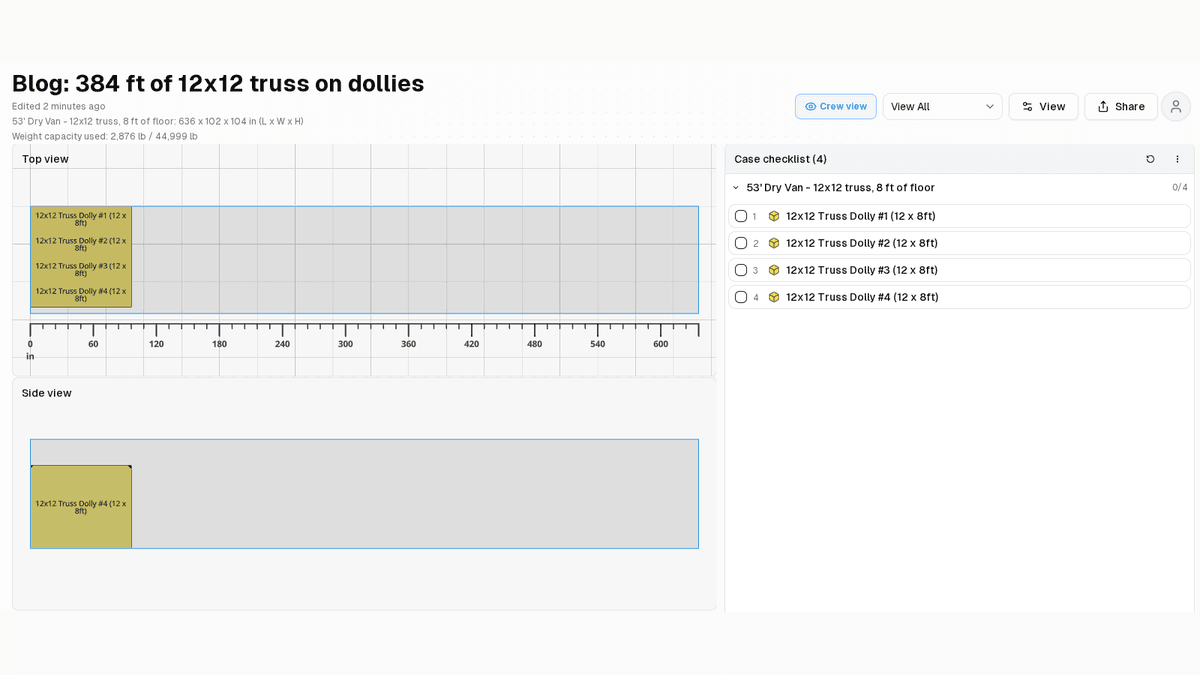
384 feet of 12x12 on four dollies: one 8-foot row across the nose.
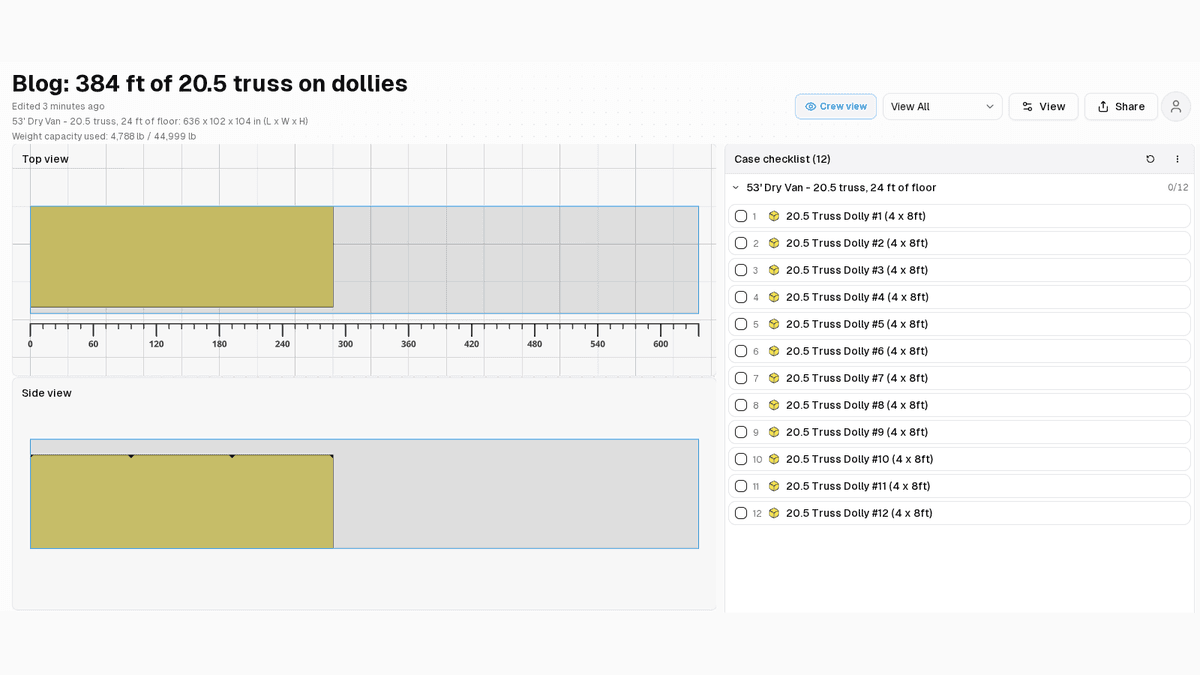
The same 384 feet in 20.5 box takes 12 dollies and 24 feet of the trailer.
You can't just spec the small truss to save the truck, though. On a 40-foot simple span, Tomcat's own load tables give the 12x12 an allowable uniform load of 27 lb per foot, while the 20.5 carries 77 lb per foot. Once you hang real fixtures, video or line arrays across a real span, the LD picks the bigger box and the bigger box picks the truck count. And in my experience the big stuff often rides with fixtures still hung inside it, which makes each dolly even taller and harder to stack anything on.
The takeaway is to get the truss plan early and pack it first. Every other number in the load plan moves around it, and it's a lot easier to have the two-trucks-or-three conversation in advance than at 2am at the dock.
Got a truss plot? Log in to Truck Packer, drop in the Tomcat, Tyler or JTE rows from the library, and see how many trailers it really takes.

