Wembley, Then North America, Then South America: Why One Tour Needs Two Sets
Slipknot's 2027 stadium run goes London, North America, South America. One set can't make that by sea. Here's the two-set math, and what changes when the pack goes from a 53' trailer to a 40' high cube.

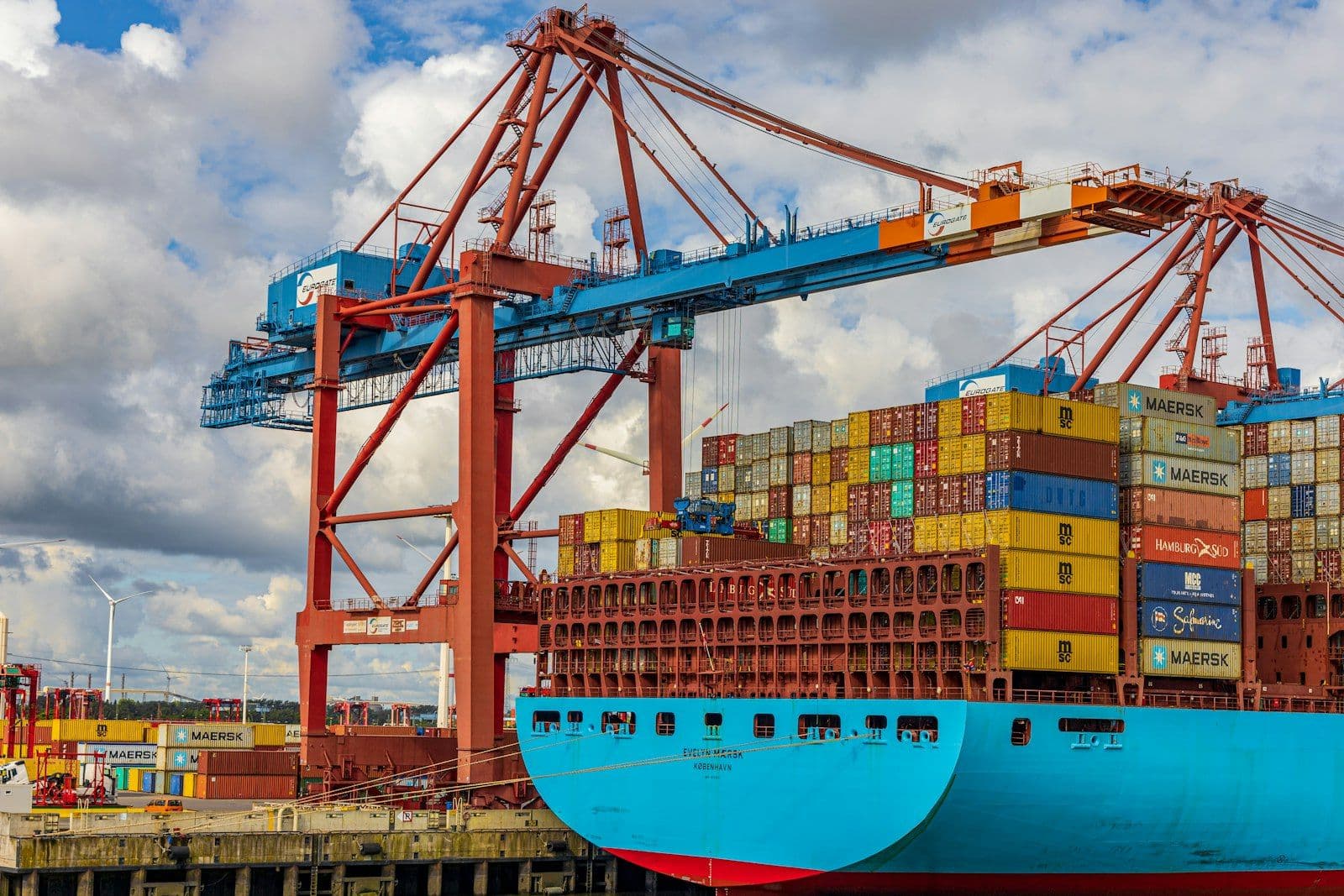
Slipknot just announced the (sic)est Stadium Tour for summer 2027, and the routing is a good lesson in how big tours actually move. It opens July 3 at Wembley Stadium in London. Thirteen days later it's at Nationals Park in Washington, DC, for a North American run that ends August 15 in Phoenix. Then it goes to South America in September for shows in Brazil, Argentina, Chile, Peru and Colombia. Live Nation is billing it as a brand-new set and new staging.
Look at that calendar with a freight hat on and one thing jumps out. There's no way a single set of gear makes all three legs by sea. So the production is either flying a lot of steel or carrying more than one set. I don't know Slipknot's freight plan, but here's how the math works, and it's the same math any tour crossing an ocean has to do.
One set can't make this routing
Start with Wembley to DC. Thirteen days between shows has to cover the load-out, trucking to a port, the crossing, customs and trucking to the next stadium. That doesn't leave room for an ocean leg, so the North American dates need their own set or a very expensive air charter.
Now look at the back end. Phoenix is August 15 and South America starts in September. Ocean freight from the US East Coast to Brazil runs 18 to 25 days, and that's before you truck a desert show across the country to the port. The same page notes port congestion can add 7 to 10 days and that only 23 percent of vessels sailed on schedule in 2024. You can't build a stadium opener on a ship that might be ten days late.
The set that sails ahead
So here's the version that works. The set that plays Wembley doesn't follow the band to America. It gets loaded into containers and put on a ship to South America. Europe to Santos is about 30 to 35 days, which lands it in August with weeks of slack before the first South American show. Meanwhile a second set does the North American run on trucks, and the band flies between them.
This isn't new. Big stadium tours have run two or more systems for years, with one set packing up after a show while the other is already on its way to the next leg. U2's 360 tour ran three. The same source says freight forwarders want 3 to 6 months to plan a tour's transport, which is about where a July 2027 opener sits right now.
A container isn't a trailer
Here's where the pack changes. Most of us think in 53-foot trailers, about 636 by 102 inches inside. A 40-foot high cube is about 12,032 by 2,350 millimeters inside, which is roughly 474 inches long and 92.5 inches wide. You lose about 13 feet of length and 9.5 inches of width.
That width is the one that bites. A trailer takes four 24-inch-wide cases across with room to spare. A container doesn't, because four of them is 96 inches. A pack that's been running all summer in trailers has to be re-planned in 30-inch bays three across, or you find out at the port. You also load it only from the doors, so whatever goes in first is the last thing you see in Santos.
Here's an example. I built one container of a sailing set in Truck Packer: twelve two-motor chain hoist cases at the nose (steel first), nine moving light 4-ways, six line array carts, six amp racks and six cable trunks at the doors. It's 39 cases and 25,200 pounds, and it fits in the high cube with about 20 inches to spare. Here is the pack if you want to open it.
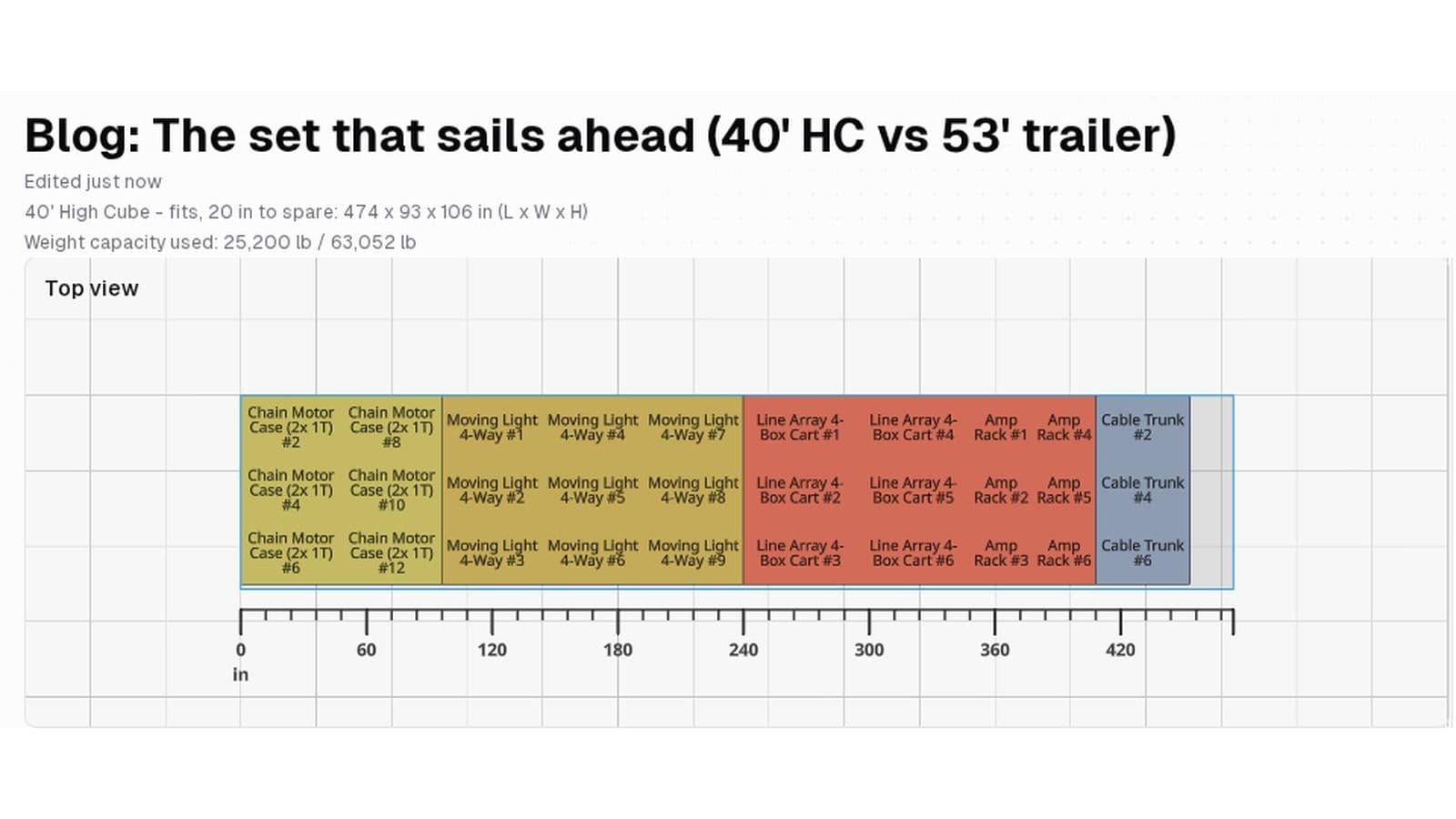
Top view: three 30-inch cases across a 92.5-inch box, with 20 inches left at the doors.
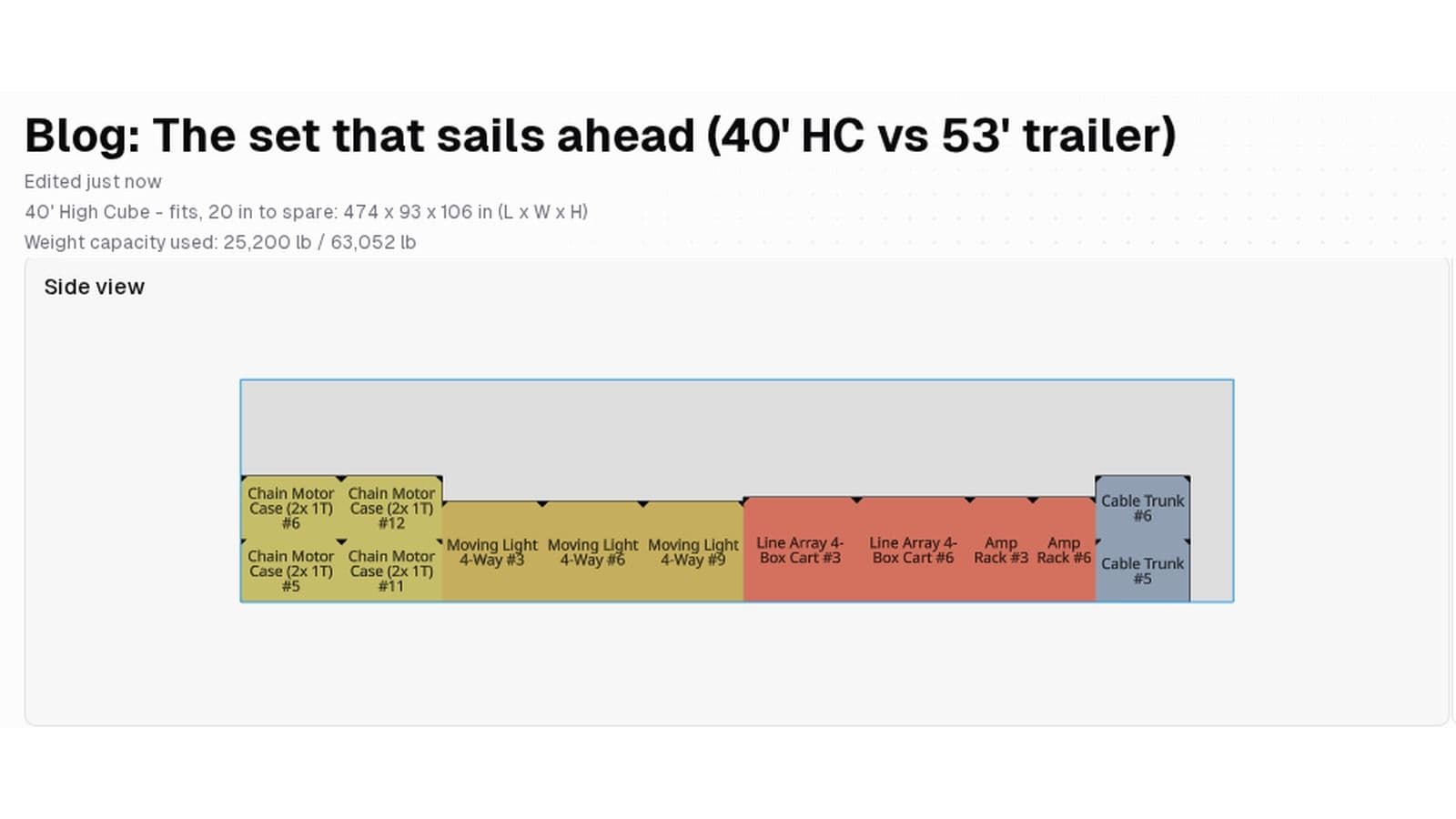
Side view: motors and cable trunks two high, everything else on the deck.
The same pack has a 53-foot trailer next to it with the identical load, and that trailer has 15 feet of open floor. So one trailer's worth of this gear is about one and a third containers. That's the ratio you want before you book boxes, not after.
Paperwork travels with the boxes
A set crossing borders needs a carnet or a broker plan for every country on the run. Brazil joined the ATA carnet system in 2016, and it covers professional equipment. Acceptance varies by country, so confirm each stop with your broker. Every case number on the carnet has to match what's in the box, which is one more reason to have the container plan settled before it leaves.
The takeaway
When a tour jumps continents, think about which set goes where before you think about trucks. Then re-plan the pack for the container instead of assuming the trailer pack carries over. Twenty inches of slack in a high cube is fine. Four inches too wide at the port is a missed ship.
Planning a load that has to fit a container? Log in to Truck Packer and pack it.

